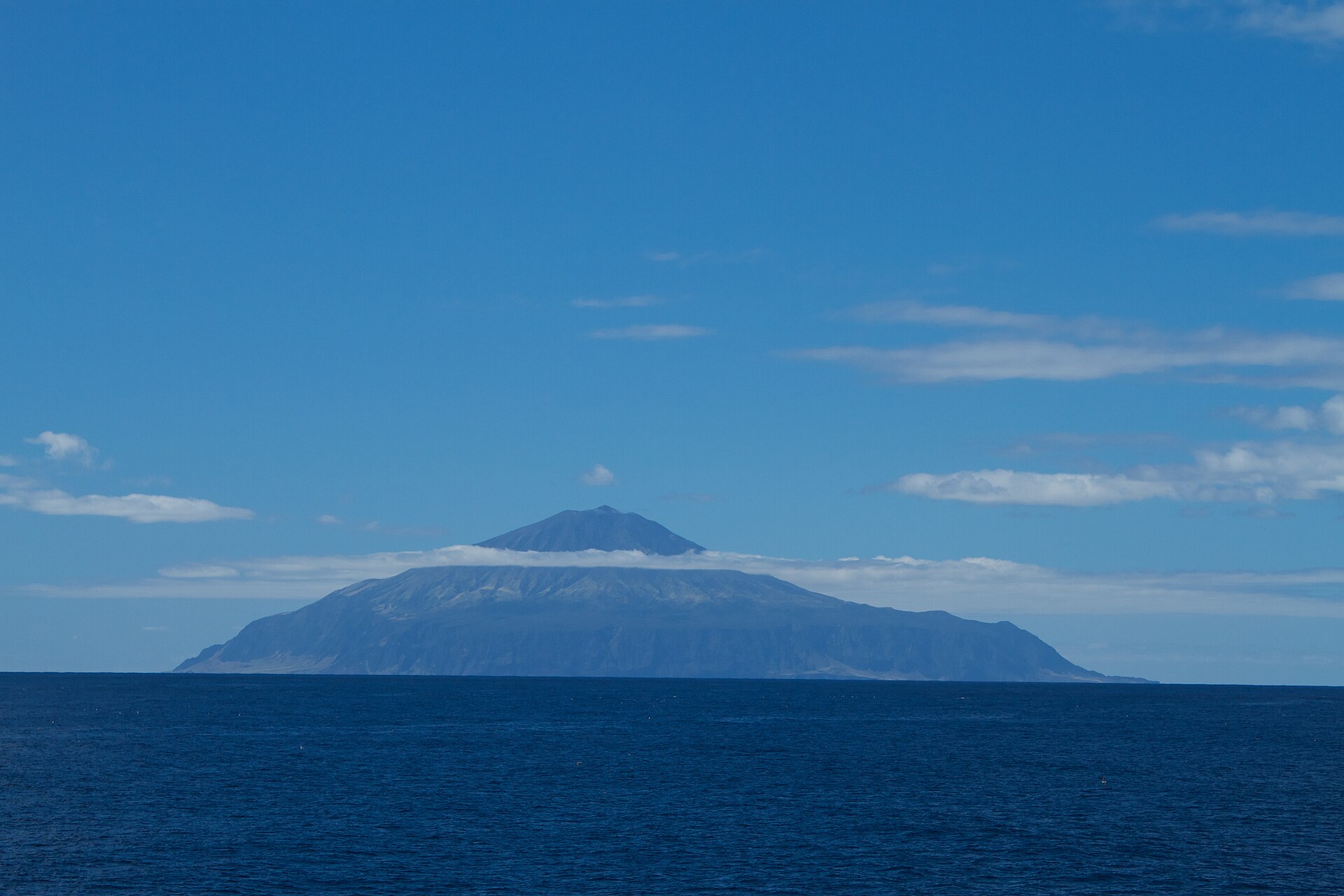
Tristan da Cunha sits roughly 2,800 kilometres from South Africa and about 3,700 kilometres from South America, a volcanic cone with one settlement, Edinburgh of the Seven Seas, built on the only flat ground available. In 1961 that geography stopped being a travel-writer's detail and became the whole story: the island itself moved, cracked open, and sent its people to sea.
The eruption, in sequence
Tremors had been felt for weeks before the ground near the settlement split open on 10 October 1961. A new volcanic vent rose close to the village, within a few hundred metres of the houses, and lava began advancing toward the factory where the island's crayfish catch was processed and toward the only harbour landing. There was no warning system beyond what the islanders felt underfoot. The decision to evacuate the entire population, 264 people at the time, was made within days rather than weeks.
Leaving: the logistics of 264 people
There was no airstrip then, and there still isn't one now. The only way off was by sea. Islanders were first taken by boat to Nightingale Island, a short crossing within the Tristan group, then picked up by a passing ship and carried to Cape Town, a voyage of several days across open South Atlantic water. From Cape Town most of the group travelled on to England, arriving to winter weather, city crowds and a language that was technically their own but culturally unfamiliar after generations of near-total isolation. Housing was arranged in Hampshire, at a former military camp, and the islanders spent close to two years there.
264 people evacuated in 1961 is roughly the same headcount as the island's population today, which hovers around 240. The 1961 group was, in effect, the entire village, not a subset of it.
Life in England, 1961 to 1963
Government and press attention was considerable at the time, partly because a self-contained community numbering in the low hundreds, with its own dialect and customs, arriving en masse was unusual. Some islanders found seasonal and factory work. Children attended English schools. A scientific expedition was sent back to the island during this period to assess the damage and the ongoing volcanic activity, and its reports fed directly into the eventual decision about return. The stay was not brief: almost two full years passed, enough time for some islanders to consider staying permanently, though in the end the overwhelming majority chose not to.
Why most chose to return
The settlement had not been destroyed. Lava flows had stopped short of the main village, though the crayfish factory, the island's principal source of cash income, was damaged and had to be rebuilt. Assessment teams judged the volcanic activity to have subsided enough for safe resettlement. For a community whose identity was built around communal landholding, fishing rights and a specific patch of flat coastal ground, England offered wages but not the same footing. By 1963 a formal return had been organised, again by sea, and the great majority of the 1961 evacuees went home.
What remains visible today
The 1961 lava field is still there, a dark, rough apron of rock on the edge of the settlement, close enough to walk to from the village in well under an hour. It has become, in a quiet way, part of the everyday backdrop rather than a memorial site with signage or facilities; there is none of that on Tristan. The volcano itself, Queen Mary's Peak, rises to just above 2,000 metres and is still monitored, though not with the frequency of a full seismic network, given the island's remoteness and small population. Islanders speak of 1961 less as a disaster story and more as a fact of the family record: most households can tell you which relatives were on which ship.
Visiting with this history in mind
There is no scheduled passenger transport to Tristan; travel is still by sea, on fishing vessels, supply ships or the occasional yacht, and the crossing from Cape Town typically takes about six days depending on weather. Berths are limited and the schedule depends on cargo and fishing runs, so dates should be treated as approximate until confirmed closer to departure. Anyone visiting the lava field or the settlement should check the day's schedule with island contacts before planning, since weather and landing conditions can shift arrangements at short notice. The 1961 eruption is not presented as a tourist attraction on Tristan; it is simply part of how residents explain why the village sits exactly where it does.